|
|
|---|
1. Tews G
Das Problem der Mehrlinge nach ART ā€“ Entwicklung in Ć–sterreich und ein Vergleich mit den Anrainerstaaten
Embryo-Transfer
Journal für Gynäkologische Endokrinologie 2013; 7 (1) (Ausgabe für Österreich): 10-12
(a) Entwicklung der Transfers in Ć–sterreich 2002ā€“2011; (b) Entwicklung der Double-Embryo-Transfers in Ć–sterreich 2002ā€“2011, Entwicklung der Zwillingsanlagen. Daten: Ć–sterreichischer IVF-Fonds. Keywords: Diagramm,
Embryo-Transfer,
Gynäkologie,
Mehrlinge,
Reproduktion,
Reproduktionsmedizin
|
|
|
2. Ebner T;
Vanderzwalmen P;
Shebl O;
Mayer RB;
Moser M;
Tews G
Morphological Aspects of Human Blastocysts and the Impact of Vitrification
Blastocyst
Journal für Reproduktionsmedizin und Endokrinologie - Journal of Reproductive Medicine and Endocrinology 2011; 8 (1): 13-20
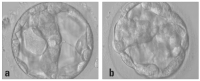
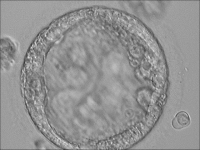
Expanded blastocyst (IVaa) before vitrification (a). Full re-expansion is not reached 2h after warming (b). Keywords: Biologie,
blastocyst,
Blastozyste,
Embryologie,
Reproduktionsmedizin
|
|
|
|
|
|
4. Ebner T;
Vanderzwalmen P;
Shebl O;
Mayer RB;
Moser M;
Tews G
Morphological Aspects of Human Blastocysts and the Impact of Vitrification
Blastocyst
Journal für Reproduktionsmedizin und Endokrinologie - Journal of Reproductive Medicine and Endocrinology 2011; 8 (1): 13-20
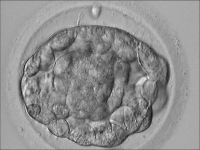
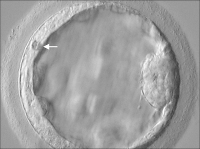
Expanded blastocyst (IVaa) showing characteristic
cytoplasmic strings (arrows) within the blastocoel. Keywords: Biologie,
blastocyst,
Blastozyste,
Embryologie,
Reproduktionsmedizin
|
|
|
5. Ebner T;
Vanderzwalmen P;
Shebl O;
Mayer RB;
Moser M;
Tews G
Morphological Aspects of Human Blastocysts and the Impact of Vitrification
Inner cell mass
Journal für Reproduktionsmedizin und Endokrinologie - Journal of Reproductive Medicine and Endocrinology 2011; 8 (1): 13-20
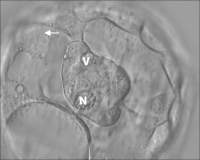
Inner cell mass of optimal size and shape.
Reduction in developmental potential is due to the presence of vacuole (V) and necrotic focus (N). Keywords: Biologie,
Embryologie,
inner cell mass,
innere Zellmasse,
Reproduktionsmedizin
|
|
|
6. Ebner T;
Vanderzwalmen P;
Shebl O;
Mayer RB;
Moser M;
Tews G
Morphological Aspects of Human Blastocysts and the Impact of Vitrification
Trophoblast vesicle
Journal für Reproduktionsmedizin und Endokrinologie - Journal of Reproductive Medicine and Endocrinology 2011; 8 (1): 13-20
Trophoblast vesicle without inner cell mass
consisting of only a minor number of trophectodermal
cells. Keywords: Biologie,
Embryologie,
Reproduktionsmedizin,
Throphoblast,
trophoblast vesicle
|
|
|
|
|
|
8. Ebner T;
Vanderzwalmen P;
Shebl O;
Mayer RB;
Moser M;
Tews G
Morphological Aspects of Human Blastocysts and the Impact of Vitrification
Blastocyst
Journal für Reproduktionsmedizin und Endokrinologie - Journal of Reproductive Medicine and Endocrinology 2011; 8 (1): 13-20
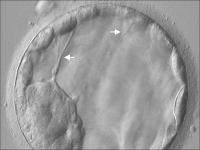
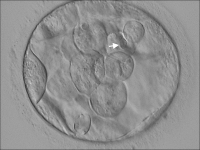
Full blastocyst (IIIbb) showing cell lineages
with a limited number of cells. Arrow indicates presence of a necrotic focus in the inner cell mass. Keywords: Biologie,
blastocyst,
Blastozyste,
Embryologie,
Reproduktionsmedizin
|
|
|
9. Ebner T;
Vanderzwalmen P;
Shebl O;
Mayer RB;
Moser M;
Tews G
Morphological Aspects of Human Blastocysts and the Impact of Vitrification
Blastocyst
Journal für Reproduktionsmedizin und Endokrinologie - Journal of Reproductive Medicine and Endocrinology 2011; 8 (1): 13-20
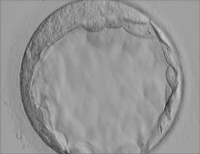
Blastocyst (IVcb) with no visible inner cell
mass (comparable to trophoblast vesicle). Trophectoderm
quality is reduced since the left hemisphere consists
only of a few large cells. Keywords: Biologie,
blastocyst,
Blastozyste,
Embryologie,
Reproduktionsmedizin
|
|
|
10. Ebner T;
Vanderzwalmen P;
Shebl O;
Mayer RB;
Moser M;
Tews G
Morphological Aspects of Human Blastocysts and the Impact of Vitrification
Blastocyst - Hatching
Journal für Reproduktionsmedizin und Endokrinologie - Journal of Reproductive Medicine and Endocrinology 2011; 8 (1): 13-20
Hatching blastocyst of optimal quality (Vaa)
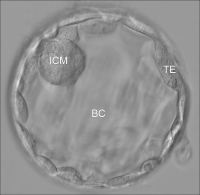
with the hatching site being at the 4 oā€™clock position. BC: blastocyst cavity; ICM: inner cell mass; TE: trophectoderm Keywords: Biologie,
blastocyst,
Embryologie,
Hatching,
Reproduktionsmedizin
|
|
|
11. Sommergruber M;
Aburumieh A;
Dohr G;
Feichtinger W;
Hengstschläger M;
Huber J;
Moser M;
Pusch H;
Szalay S;
Tews G;
Urdl W;
Wildt L;
Zech H;
Spitzer D
Karzinomrisiko bei assistierter Reproduktion. Stellungnahme der Österreichischen Gesellschaft für Reproduktionsmedizin und Endokrinologie
ART - Karzinomrisiko
Journal für Reproduktionsmedizin und Endokrinologie - Journal of Reproductive Medicine and Endocrinology 2009; 6 (3): 116-121
Ein querovales Symbol bezeichnet den Beginn oder das Ende des Prozessablaufes/beschriebenen Prozesses. Ein aufgestelltes Quadrat stellt ein Entscheidungsfeld
dar: dabei wird eine Frage jeweils so formuliert, dass die Antwort nur ā€žjaā€œ oder ā€žneinā€œ lauten darf. Ein Rechteck wird Aktionsfeld genannt und bezeichnet eine durchzufĆ¼hrende
TƤtigkeit. Die Symbole selbst werden mit Pfeilen verbunden. Die Pfeilspitzen zeigen die einzuhaltende Abfolge der Prozessschritte. Keywords: Karzinomrisiko,
Schema
|
|
|
12. Ebner T;
Moser M;
Tews G
Die Bedeutung der Morphologie der Oozyte hinsichtlich ihres weiteren Entwicklungspotentials
Oozyte - Zona pellucida
Journal für Reproduktionsmedizin und Endokrinologie - Journal of Reproductive Medicine and Endocrinology 2006; 3 (1): 17-23
Ovale Eizelle, deren innere Zonaschicht sich abgelöst hat. Keywords: Eizelle,
Gynäkologie,
Oozyte,
Zona pellucida
|
|
|
13. Ebner T;
Moser M;
Tews G
Die Bedeutung der Morphologie der Oozyte hinsichtlich ihres weiteren Entwicklungspotentials
Oozyte - Granula
Journal für Reproduktionsmedizin und Endokrinologie - Journal of Reproductive Medicine and Endocrinology 2006; 3 (1): 17-23
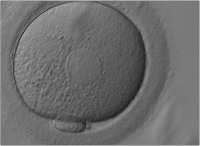
Eizelle mit Granula im perivitellinen Spalt. Keywords: Eizelle,
Granula,
Gynäkologie,
Oozyte
|
|
|
14. Ebner T;
Moser M;
Tews G
Die Bedeutung der Morphologie der Oozyte hinsichtlich ihres weiteren Entwicklungspotentials
Oozyte - Endoplasmatisches Retikulum
Journal für Reproduktionsmedizin und Endokrinologie - Journal of Reproductive Medicine and Endocrinology 2006; 3 (1): 17-23
MII-Eizelle mit einer zentralen Aggregation des glatten
endoplasmatischen Retikulums. Keywords: Eizelle,
endoplasmatisches Retikulum,
Gynäkologie,
Oozyte
|
|
|
15. Ebner T;
Moser M;
Tews G
Die Bedeutung der Morphologie der Oozyte hinsichtlich ihres weiteren Entwicklungspotentials
Oozyte - Vakuolen
Journal für Reproduktionsmedizin und Endokrinologie - Journal of Reproductive Medicine and Endocrinology 2006; 3 (1): 17-23
Stark vakuolisierte Eizelle Keywords: Eizelle,
Gynäkologie,
Oozyte,
Vakuole
|
|
|
16. Ebner T;
Moser M;
Tews G
Die Bedeutung der Morphologie der Oozyte hinsichtlich ihres weiteren Entwicklungspotentials
Oozyte - refraktiler Körper
Journal für Reproduktionsmedizin und Endokrinologie - Journal of Reproductive Medicine and Endocrinology 2006; 3 (1): 17-23
Oozyte mit dominantem refraktilem Körper. Keywords: Eizelle,
Gynäkologie,
Oozyte,
refraktiler Körper
|
|
|
17. Ebner T;
Moser M;
Tews G
Die Bedeutung der Morphologie der Oozyte hinsichtlich ihres weiteren Entwicklungspotentials
Oozyte - reifer Gamet
Journal für Reproduktionsmedizin und Endokrinologie - Journal of Reproductive Medicine and Endocrinology 2006; 3 (1): 17-23
Reifer Gamet mit vier größeren und zwei kleineren
Inkorporationen. Keywords: Eizelle,
Gamet,
Gynäkologie,
Inkorporation,
Oozyte
|
|
|
|
|
|
19. Ebner T;
Moser M;
Tews G
Die Bedeutung der Morphologie der Oozyte hinsichtlich ihres weiteren Entwicklungspotentials
Reife Oozyte
Journal für Reproduktionsmedizin und Endokrinologie - Journal of Reproductive Medicine and Endocrinology 2006; 3 (1): 17-23
Reife Oozyte mit stark fragmentiertem erstem Polkörper. Keywords: Eizelle,
Gynäkologie,
Oozyte,
Polkörper
|
|
|
20. Ebner T;
Moser M;
Tews G
Die Bedeutung der Morphologie der Oozyte hinsichtlich ihres weiteren Entwicklungspotentials
Diploide Rieseneizelle
Journal für Reproduktionsmedizin und Endokrinologie - Journal of Reproductive Medicine and Endocrinology 2006; 3 (1): 17-23
Diploide Rieseneizelle (205 µm) in Metaphase II mit zwei
deutlich sichtbaren ersten Polkörperchen. Keywords: Eizelle,
Gynäkologie,
Oozyte,
Polkörper
|
|
|
21. Ebner T;
Moser M;
Sommergruber M;
Tews G
Die Bedeutung der Analyse der Metaphase-II-Spindel in der assistierten Reproduktion
Polscopeaufnahme
Journal für Reproduktionsmedizin und Endokrinologie - Journal of Reproductive Medicine and Endocrinology 2005; 2 (2): 78-83
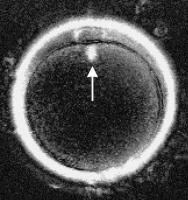
Polscopeaufnahme der meiotischen Spindel (Pfeil), die sich in unmittelbarer Nähe des ersten Polkörperchens befindet (mit freundlicher Genehmigung P. Gaßner). Keywords: Embryologie,
Metaphasespindel,
Polscope,
Reproduktionsmedizin
|
|
|
22. Ebner T;
Moser M;
Sommergruber M;
Tews G
Die Bedeutung der Analyse der Metaphase-II-Spindel in der assistierten Reproduktion
Polscopeaufnahme
Journal für Reproduktionsmedizin und Endokrinologie - Journal of Reproductive Medicine and Endocrinology 2005; 2 (2): 78-83
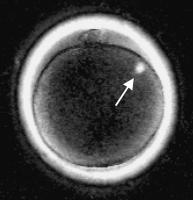
Polscopeaufnahme einer dislozierten meiotischen
Spindel (Pfeil, mit freundlicher Genehmigung L. Rienzi). Keywords: Embryologie,
Metaphasespindel,
Polscope,
Reproduktionsmedizin
|
|
|
23. Tews G;
Ebner T;
Jesacher K
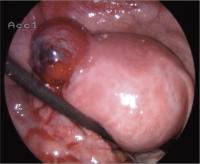
Besonderheiten der ektopen Schwangerschaft nach IVF/ICSI
Laparoskopie - Heterotope Schwangerschaft
Journal für Reproduktionsmedizin und Endokrinologie - Journal of Reproductive Medicine and Endocrinology 2004; 1 (4): 268-271
Laparoskopisches Bild einer heterotopen Schwangerschaft mit zweimaliger positiver Herzaktion Keywords: Gynäkologie,
heterotope Schwangerschaft,
Laparoskopie
|
|
|
24. Tews G;
Ebner T;
Jesacher K
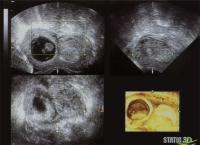
Besonderheiten der ektopen Schwangerschaft nach IVF/ICSI
Embryo - 3D-Ultraschall
Journal für Reproduktionsmedizin und Endokrinologie - Journal of Reproductive Medicine and Endocrinology 2004; 1 (4): 268-271
Verbesserte Diagnostik durch Einsatz eines 3D-Ultraschallgerätes mit Darstellung des ektop im Uterushorn liegenden Embryos mit positiver Herzaktion. Keywords: 3D-Ultraschall,
Diagnostik,
Embryo,
Gynäkologie
|
|
|
|
|
|
26. Ebner T;
Moser M;
Sommergruber M;
Tews G
Schwangerschaft nach ausschließlicher intrazytoplasmatischer Injektion von Spermien mit abnormer Geißelbildung
Expandierter Blastozyst
Journal für Urologie und Urogynäkologie 2004; 11 (3) (Ausgabe für Österreich): 24-28
Journal für Urologie und Urogynäkologie 2004; 11 (3) (Ausgabe für Schweiz): 28-30
Journal für Urologie und Urogynäkologie 2004; 11 (3) (Ausgabe für Deutschland): 26-28
Expandierter Blastozyst (ca. 195 µm) am 5. Tag der Kultur. Der Pfeil kennzeichnet die innere Zellmasse. Die sichelförmigen Zellen,
die das Blastocoel auskleiden, sind dem Trophektoderm zuzurechnen (100fache Vergrößerung). Keywords: Andrologie,
blastozyst,
Trophektoderm,
Urogynäkologie,
Zellmasse
|
|
|
27. Ebner T;
Moser M;
Sommergruber M;
Tews G
Schwangerschaft nach ausschließlicher intrazytoplasmatischer Injektion von Spermien mit abnormer Geißelbildung
Spermatozoon
Journal für Urologie und Urogynäkologie 2004; 11 (3) (Ausgabe für Österreich): 24-28
Journal für Urologie und Urogynäkologie 2004; 11 (3) (Ausgabe für Schweiz): 28-30
Journal für Urologie und Urogynäkologie 2004; 11 (3) (Ausgabe für Deutschland): 26-28
a. Normales Spermatozoon (ca. 50 µm) eines normozoospermen Mannes. Die Pipettenspitze markiert das Ende der Geißel. b. Morphologisch abnormales Spermium (ca. 85 µm) mit Geißeldefekt. Der Pfeil deutet das Geißelende an (400fache Vergrößerung). Keywords: Andrologie,
Deformation,
Geißel,
Spermatozoon,
Spermium,
Urogynäkologie
|
|
|
|
|
|
|
|
|
|
|
|
|
|
|
32. Ebner T;
Moser M;
Tews G
Neue Aspekte der Zygotenevaluierung
Zygote - Vorkernmuster
Journal für Reproduktionsmedizin und Endokrinologie - Journal of Reproductive Medicine and Endocrinology 2004; 1 (2): 71-76
Zygote mit ungleich großen (25,4 µm bzw. 17,8 µm) Vorkernen (Vorkernmuster 5); der polare Halo befindet sich links Keywords: Befruchtung,
Genetik,
Gynäkologie,
Halo-Effekt,
Mikroskopbild,
Zygote
|
|
|
|
|
|
|
|
|
35. Ebner T;
Moser M;
Tews G
Neue Aspekte der Zygotenevaluierung
Zygote - Vorkernmuster
Journal für Reproduktionsmedizin und Endokrinologie - Journal of Reproductive Medicine and Endocrinology 2004; 1 (2): 71-76
Zygote mit Vorkernmuster 0B und konzentrischem Halo (Pfeile); beide Polkörper liegen in unmittelbarer Nähe der gedachten Polarachse Keywords: Befruchtung,
Genetik,
Gynäkologie,
Halo-Effekt,
Mikroskopbild,
Polkörper,
Vorkernmuster,
Zygote
|
|
|
| |

 Suche Medizinische Publikationen
 Suche Abbildungen und Grafiken
 Medizinprodukte - Labortechnik
 Antidotarium (Stand 2012)
 Phytokodex (Stand 2012)
 Fachbücher
 Patientenliteratur