| Borchard U |
|---|
The Role of the Sympathetic Nervous System in Cardiovascular Disease
Journal of Clinical and Basic Cardiology 2001; 4 (3): 175-177
PDF Summary Figures
| Figure |
|---|
| |
|
|
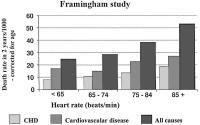
Framingham - Herzfrequenz
Figure 1: Increase in heart rate is correlated to mortality due to coronary heart disease (CHD), cardiovascular disease or all causes (modified according to [2])
Keywords: Diagramm,
Framingham-Studie,
Framingham-Studie,
heart rate,
Herzfrequenz,
Studie,
study
|
| |
| |
|
|
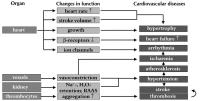
SNS-Überaktivität - kardiovaskuläre Erkrankung
Figure 2: Sustained SNS overactivity induces functional and structural changes of different organs leading to cardiovascular diseases.
Keywords: cardiovascular disease,
kardiovaskuläre Erkrankung,
Schema,
sympathetic nervous system,
Sympathikus,
sympathisches Nervensystem,
Überaktivität
|
| |
| |
|
|
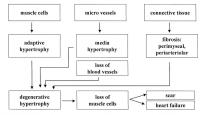
SNS-Überaktivität - Hypertrophie
Figure 3: From hypertension to heart failure: SNS overactivity leads to an increase in growth factors responsible for left ventricular hypertrophy, media hypertrophy (coronary microvessels) and fibrosis. The result may be heart failure.
Keywords: Hypertrophie,
Hypertrophy,
overactivity,
Schema,
sympathetic nervous system,
Sympathikus,
sympathisches Nervensystem,
ventricle,
Ventrikel,
Überaktivität
|
| |
| |
|
|
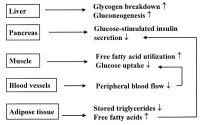
SNS-Überaktivität - Metabolismus
Figure 4: Metabolic changes due to elevated sympathetic tone: SNS overactivity leads to increased glucose production, decreased glucose utilization, increase in triglycerides and VLDL, decrease in HDL and insulin resistance (metabolic syndrome).
Keywords: Cholesterin,
cholesterol,
HDL,
HDL,
insulin resistance,
Insulinresistenz,
metabolism,
Metabolismus,
overactivity,
Schema,
sympathetic nervous system,
Sympathikus,
sympathisches Nervensystem,
triglyceride,
Triglyzeride,
VLDL,
VLDL,
Überaktivität
|
| |
| |
|
|
Moxonidin - Imidazolinrezeptor
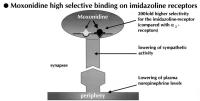
Figure 5: Moxonidine selectively stimulates I1-receptors in the rostral ventrolateral medulla (RVLM). The sympathetic outflow from the RVLM to the periphery is decreased.
Keywords: Imidazolin,
Imidazoline,
Medulla,
Medulla,
Moxonidin,
moxonidine,
Receptor,
Rezeptor,
Schema,
Stimulation,
Stimulation
|
| |
| |
|
|
Imidazolinantagonisten
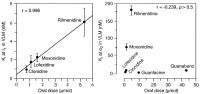
Figure 6: There is a strong correlation between the affinity of different I1-agonists at the I1-receptor in the ventrolateral medulla (VLM) and the oral dose needed to lower blood pressure in hypertensive patients. There is no such correlation for Ki at a2-receptors (modified according to [15])
Keywords: Antagonist,
Antagonist,
blood pressure,
Blutdruck,
Clonidin,
Diagramm,
hypertension,
Hypertonie,
Imidazolin,
Imidazoline,
Lofexidin,
Medulla,
Medulla,
Moxonidin,
Receptor,
Rezeptor,
Rilmenidin
|
| |
| |
|
|
 Suche Medizinische Publikationen
 Suche Abbildungen und Grafiken
 Medizinprodukte - Labortechnik
 Antidotarium (Stand 2012)
 Phytokodex (Stand 2012)
 Fachbücher
 Patientenliteratur